

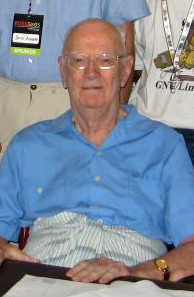
photo by Amy Marash (Mamyjomarash, CC BY-SA 4.0 https://creativecommons.org/licenses/by-sa/4.0, via Wikimedia Commons)
Previously I wrote about how I learned English as a teenager in Sri Lanka by reading science fiction. Naturally, I started with Sir Arthur C. Clarke because every kid in Sri Lanka knew about the world-famous writer living in Sri Lanka at the time. I devoured everything Clarke wrote that I could lay my hands on (thanks to the extensive collection at the British Council and American Center libraries in Kandy, Sri Lanka, as well as the several science fiction books that my uncle in Canada sent me after hearing of my interest in the genre), and loved every bit of it.
Although I was studying science and could certainly appreciate the science behind his stories, I was, at heart, a student of language . So, what excited me the most were his wonderful turns of phrase.
An example is his formulation of Clarke’s Laws, the most famous of which were “Any sufficiently advanced technology is indistinguishable from magic,” and the undeniably accurate, “When a distinguished but elderly scientist states that something is possible, he is almost certainly right. When he states that something is impossible, he is very probably wrong.”
Or consider his witticism when his friendly rivalry with Isaac Asimov, another great science and science-fiction writer, led him to make this very tongue-in-cheek dedication of his book Report on Planet Three, where he wrote ‘In accordance with the terms of the Clarke-Asimov treaty, the second-best science writer dedicates this book to the second-best science-fiction writer,‘
A third example is the title of an essay in his collection, Voices from the Sky: ‘A Short Pre-History of Comsats Or: How Lost a Billion Dollars in My Spare Time,’ which begins thus: ‘It is with somewhat mixed feelings that I can claim to have originated one of the most commercially valuable ideas of the twentieth century, and have sold it for just $40,’ and goes on to describe how as a bored flight lieutenant with the Royal Air Force at the tail end of World War II, he dreamed up the idea of how geostationary satellites can be used to set up a worldwide communication system. and sold it to the magazine Wireless World for a pittance compared to the billion-dollar business that satellite communications became, just two decades later.
This third example should have been a clue for me to appreciate Clarke’s uncanny ability to correctly imagine the future. Although I did read Profiles of the Future back then, I did not appreciate the full scope of his foresight contained within.
Recently I ran into a clip from his 1978 interview with PBS Nova, where he held forth on artificial intelligence, raising not only the obvious concerns like unemployment but also the deeper social and philosophical questions like the meaning of human life brought into focus by the rise of AI that the rest of us are starting to realize now.
His BBC interview all the way back in 1964 is a testament to his sweeping imagination and uncanny accuracy: He touches on notions like remote work (including telemedicine) brought about by the telecommunication revolution and AI. It is true that some of his predictions, like the death of business travel, did not pan out. Others, like brain-computer interfaces, cryonic suspended animation, terraforming, and star-trek style replicators may still be in the future (although not for want of trying), but have certainly become science fiction staples in the six decades since Clarke articulated them.
In his 1969 New Yorker profile of Clarke, titled Out of the Ego Chamber Jeremy Bernstein paints a vivid portrait of Clarke and his life in Sri Lanka at the height of his fame. It is a long piece, but well worth your time. I recommend it highly.
Below, I list a couple of other pieces discussing Clarke’s work and legacy:
- Hephzibah Anderson, The fiction that predicted space travel (BBC, 2019) on his science fiction and his visions of the future.
- William G. Schulz, Arthur C. Clarke: Imagining a future of hope in even the toughest of times, (SPIE, 2022) on the interactions between Clarke and Erik Viirre, Director of the Arthur C. Clarke Center for Human Imagination at University of California, San Diego



Leave a Reply