
இருளிலிருந்தே ஒளி பிறக்கிறது
Translated from the original Tamil short story iruḷiliruntē oḷi piṟakkiṟṟatu (இருளிலிருந்தே ஒளி பிறக்கிறது) from the 1976 collection of short stories titled kōṭukaḷum kōlaṅkalum (கோடுகளும் கோலங்களும்) by Kuppilan Ai. Shanmugan. The original collection is available at noolaham.org. If you have any questions or feedback, please contact ez.iniyavan@gmail.com.

Everyone refers to me as the only child of farmer Siṉṉappu. It is my great regret to have been born without siblings. But I do have a sibling in a way. She is Maṅgaiyarkkarasi. Whenever she calls out to me, ‘Sathāsivaththaṇṇaṉ,’ it makes me so happy. She is not a sibling who was born of the same parents — but I adore her to death. She is just as fond of me. When I work the well to irrigate the tobacco plants during tobacco season, she would not sit still even if āchchi is delayed in sending me food. She would say, “Poor aṇṇaṉ, he is toiling in this heat,” and sit down to help āchchi to make sure that my food gets sent. Earlier, when she was studying at Ramanathan College, she would buy me M.G.R photos in different new poses and books with film song lyrics, because she knew I liked them.
She, too, was an only child. Her father was the head teacher in our village school. We all call him the head teacher. Elders like our parents refer to him as ‘Thiruneeṟṟuch chaṭṭampiyār.’ Always in a white vēṭṭi and a ‘national’ shirt, I often see him walking down the road to his school. When I see the three thick bands of thiruneeṟu on his forehead with a big circular sandalwood poṭṭu in the middle, and the little bobbing topknot on the back of his head, I am overcome with a devotion, nay, fear as though I want to bring my hands together to worship him. If he happened to see me on the way, his eyes would widen, and he would ask with a slight smile, “How are you Sathāsivam?” A chill would come over me and my hair would bristle. Maṅgaiyarkkarasi is the darling daughter of such a personality. As much as his presence invoked a mixture of fear and joy in me, I could never tire of looking at her with fondness. When she talks to me, her chatter peppered with ‘Sathāsivaththaṇṇaṉ’ in every other sentence, I would even forget hunger. She would tell me so many stories and regale me with stories of movies featuring M.G.R and Sivaji.
Their new concrete house was just a couple of doors from ours. But she spent much of her time at our house. During the school holidays, she spent all her time at our house, going to hers only to sleep. If āchchi was unwell, she would take over the cooking duties. Otherwise, she would busy herself with helping āchchi with her chores. She wouldn’t care if some food was old or new, good or pleasant, even if āchchi protested “You aren’t used to this, child,” she would insist on tasting it. If there was some occasion for celebration in our house, she would be running it from the front, chatting jovially with everyone, joking without any inhibition. Countless are the times when I heard someone say, “Thiruneeṟṟuch chaṭṭampiyār’s daughter is a good kid.” It made me really really happy. My chest would brim with pride, thinking, ‘She is my thaṅgachchi!’
If there was a celebration in their family, she would insist that I go to their house. She knew that I would refuse. I couldn’t bear to be in the proximity of thiruneeṟṟu vāththiār. Sometimes I wonder how Maṅgaiyarkkarasi tolerated being in his presence. I would ask her what right an illiterate farmer wearing a dirty vēṭṭi have to stand next to the god. She would say, “Aiyā loves to see you. You are scared for no reason.” Listening to her pleading, I would tear up. But I would be at a loss to figure out how on earth I could mingle with the god-like vāththiār or the other white-vēṭṭi-clad men who would be visiting their house. “I can’t, thaṅgachchi, let me be,” I would beg her in a halting voice. “OK, aṇṇā,” she would give up and walk away. I would hide in a corner and cry my heart out until the heavy burden in my chest melts away.
I went to school only till the third grade. When I was in third grade, Maṅgaiyarkkarasi was in kindergarten. I was still in third grade as she progressed through first and second grades. After that I stopped going to school. I no longer wanted to go to school. Appu beat me, telling me to go to school. But I didn’t. Even Maṅgaiyarkkarasi asked me to go to school with her. I didn’t. Even the head teacher spoke to me one day, “Why don’t you come back to school? You would need to have a basic education to succeed in life.” I stood mum. Even in those days, I did not open my mouth in his presence. That day, I came home and wept. I didn’t cry when my own Appu beat me, telling me to go back to school. But when the head teacher asked me to come back to school, I could not control myself. I cried my heart out. Āchchi asked me why I was crying. I didn’t respond. I just cried.
I could never understand what they learned in grades nine and ten. Our Maṅgaiyarkkarasi went to Kandy to study in thirteenth or fourteenth grade! I once asked her, “What do you study in Kandy?” “You wouldn’t understand all that aṇṇā,” she said flatly. It is true that I couldn’t understand all that. I do read Tamil newspapers like Vīrakēsari, Thiṉakaran, and īḻanādu haltingly, letter by letter. I can even read the M.G.R. film song lyric books. Maṅgaiyarkkarasi reads big story books. I would love to read big books like that, too. But then how could I, who only went to third grade, read books that someone like Maṅgaiyarkkarasi who went to thirteenth or fourteenth grade reads. I don’t have the time to read anyway. So, I never figured out what they learn in grades thirteen or fourteen.”
For a while, I thought they learn English in higher classes. But if I could learn to read in Tamil by the time I reached the third grade, then I guess it is enough to study till the sixth grade to be able to read in English. Why then are there grades beyond that? Why did Maṅgaiyarkkarasi go to Kandy to learn.
Once when she was home on vacation, she got a letter in English. I took the letter from the postman and handed it to her. It was filled with squiggly English writing. It looked just like the prescription that the apothecary scribbles in English when I have a running fever. I was thrilled that my thaṅgachchi, too, got a letter in English. I couldn’t help grinning as I took the letter to her. She had heard the postman’s bicycle bell and had come out of the house. “Why are you grinning, aṇṇā?” she asked as she took the letter from me. I wanted to see her read in English. So, I asked, ‘What does the letter say?’
She curled her lips; “I don’t understand English aṇṇā,” she said.
I was totally disappointed. “What did all that big education get you then?” I hissed. She laughed. I couldn’t control my tears. I covered my face and ran into the house to sit in a corner and cry.
I didn’t notice that she had followed me inside. She asked, “Why are you crying, aṇṇā?” She wiped my tears, saying that I was a big baby. “You are acting like a little kid,” she mocked me.
I asked, “What are you learning at the university in Kandy, if you are not learning English?” University is the school she goes to in Kandy. “You won’t understand all that aṇṇā”, she said. “Why should we learn the language of the white man now that he has left our country?” she asked. “We can do everything in our country using Tamil and Sinhala,” she said.
I didn’t really understand everything she said, I understood only a little. Why should we care about the white men’s language after they have left. We do, after all, write big books in Tamil. So why couldn’t we write little letters in Tamil as well? I didn’t think of all this with my third-grade education. It is my thaṅgachchi who is studying in the thirteenth or fourteenth grade who came up with these ideas. When I think about it, what she said makes sense. Perhaps this is what they learn in thirteenth and fourteenth grades.
Apparently, a white man had visited our own fields. Back when the railroad was being laid here, a white man who came to supervise the work had entered our field to help himself to some long beans. My āchchi, who was then a young woman, had demanded that the white man pay for the long beans he took. He paid her one rupee and had asked her something in English. Āchchi had blushed and ran into the house. Back then, it seemed that one rupee could buy as much as ten measures of rice. Now that such white men have already left, why do we need English, indeed!
One evening, as dusk was settling in, as I was going to irrigate the fields, carrying a spade, I noticed two pants-clad young men on bicycles hanging around our house. My thaṅgachchi was washing clothes at their well. I was incensed: why do these rascals want to ogle at my sister? I walked towards them. One of them said to the other, “Look your bird is here.” The other looked at the well and smiled. For a moment, it looked like my thaṅgachchi smiled back at them. How dare they! I glared at the men on bicycles. I was holding a spade. Perhaps that scared them. They took off like bullets and disappeared. Had they stayed, who knows, I might have had reason to use the spade.
That night, the moon was full. I loved to irrigate the fields on full moon nights, drawing water from the well while belting out M.G.R. movie songs. But that night, I was dejected. Did Maṅgaiyarkkarasi smile at those men? It looked like that. But it was dusk. Perhaps she just lifted her head, and I might have misinterpreted it as a smile. She wouldn’t have smiled at strange men. She is thiruneeṟṟuch chaṭṭampiyār’s daughter, my thaṅgachchi. These thoughts rushed through my mind. I felt a lump in my throat, and an irresistible urge to cry.
It was just four or five days ago that she got her results. It seems she has passed her exams. Now she is some V.A. or B.A. it seems. She came running to our house, hopping and skipping all the way, and asked āchchi, “Where is ‘Sathāsivaththaṇṇaṉ?” “Why?” I demanded. “Aṇṇai, I have passed the exam. I’m going to give you a gift,” she said. I was thrilled that my thaṅgachchi passed the exam. She held out a parcel in her hand but teased me by pulling her hand back when I reached out to take it. I leapt towards her, grabbed the parcel, and opened it.
I was elated. She is truly my thaṅgachchi. I wanted to scoop her up and hug her tightly. But she ran away to āchchi, saying “Aṇṇan is still a baby.”
Her gift was a blue terylene shirt. Earlier, before she went off to university, she gave me a yellow terylene shirt. That was the only shirt I had all these days. I don’t usually wear a shirt, except sometimes when I go to the city, riding doubles on bicycles with other field hands to see the late-night show of an M.G.R fight movie.
Sometimes when thaṅgachchi was home on vacation from the university, I went to the movies with her. Even if I tried to wriggle out of it, she wouldn’t give up. “How can I go alone to see the movie, aṇṇā? I need a male relative to chaperone me. You come with me, I will take care of everything else,” she would say. What could I do? I would clean my yellow terylene shirt and outdoor vēṭṭi, put them on and take the bus with her to go see the movie. Otherwise, I don’t take the bus to go anywhere, even to the market.
She knew her way around Jaffna. She would insist that I buy a one-rupee-and-ten-cent ticket. I would flatly refuse. I would buy a sixty-five-cent ticket to sit in the gallery. Occasionally I would turn around to scan the second-class seats at the back. The last time we went a movie together, a young man seemed to be eyeing thaṅgachchi. He looked familiar, but I couldn’t place him. People in the city were like that — men and women ogling at one another equally.
When the movie ended, a couple of girls called after thaṅgachchi, “Maṅgaiyarkkarasi, Maṅgaiyarkkarasi , Maṅgaiyarkkarasi!” Thaṅgachchi introduced me to them, saying, “This is the ‘Sathāsivaththaṇṇaṉ I told you all about.” I was both happy and shy. The girl wearing the yellow sari looked like a good girl; the one with the blue sari was so-so. But the one in the short skirt… chee…I was disgusted to even look at her. Her lips were painted red. She laughed, saying “It looks like he came, too.” Thaṅgachchi laughed, too. I didn’t understand anything, but I didn’t like what was going on anyway.
Later, I told thaṅgachchi not to be friends with the short-skirt girl. “The yellow sari girl seems to be the good sort. Be friends with her,” I said. Somehow, I seemed to have taken a liking to this yellow-sari girl. She was the right sort.
Sometimes, young men on bicycles came to visit thaṅgachchi. She would hang out with them, laughing and joking. She would invite them into her home and serve them tea. The head teacher didn’t seem to mind all this!
“You are a girl. You shouldn’t hang out with young men,” I admonished her. She laughed out loud. “Aṇṇai, you are still a baby. What is wrong with men and women being friends, talking and laughing? Whether that is wrong or not depends on one’s mind,” she said. I thought about it later. There is indeed nothing wrong with men and women being friends. Now I understand what they learned in the thirteenth grade.
Yesterday, when I returned home from the fields in the evening, thaṅgachchi looked as if she was going to cry. As soon as she saw me, she started to weep. I couldn’t bear to see her cry, she who is always laughing and joking. I felt like crying too. Usually, when I cried, she would tease me asking, “Are you still a baby?” I realized that something bad must have happened to make her so sad. I wiped her tears, held her hands and begged her to tell me why she was crying. She sobbed, saying, “Aiyā wants to marry me off.”
I did not understand. A marriage is a happy occasion. I couldn’t comprehend why she was crying about the prospect of marriage. “Isn’t that a good thing? Why are you crying?” I asked.
She stopped crying and glared at me. “Suppramaṇiam, who teaches at our big school, is the groom,” she said.
I know him. Boys at the big school tell me that he is one of the good teachers; I see him from time to time riding his bicycle. Sometimes he would be softly singing devotional hymns as he pedals. Sometimes he carries big English books. Once he dropped a book while he was riding his bicycle. I was the one who picked it up for him. Like thaṅgachchi, he is also a BA or MA or something. He is indeed a good match for Maṅgaiyarkkarasi. Why does she cry?
“He is a good man. A good match for you. Why are you crying, you silly girl? I asked.
She took out a photo from her blouse and thrust it towards me: A tall man wearing long pants and a woman. I wiped my eyes and looked again carefully. The woman in the photo was thaṅgachchi indeed! The pair were smiling as they posed for the photo. The man looked familiar. Oh! It was the boy on a bicycle, ogling at thaṅgachchi. He was also the boy who was looking at her in the movie theater. My head was spinning. I felt faint, a lump in my chest, and my eyes clouded over. I felt like crying.
I suppressed the urge to cry. I looked into her eyes and demanded, “Are you really my thaṅgachchi?”
She fell at my feet and wept. “If not me, who is your sister?” she demanded. “Aiyā asked me, ‘Are you my daughter?’” she wailed. “Aṇṇai, I thought you are innocent like a baby. You, too, want to desert me?” she asked. I couldn’t control the urge to cry. “Why then did you do this, thaṅgachchi?” I asked.
She wiped her eyes and said “Why, aṇṇā? I don’t know why. I liked him, and he liked me. The responsibility of the parents stops when they marry their children off. But we are the ones who have to raise a family together. Don’t we have the wisdom to choose the person with whom we can raise a family? Aṇṇā, one should live with the person one loves. Aiyā says I must marry the one he chose. But I cannot live without him,” her eyes glistened as she pointed to the photo. I tried my best to steel myself but failed. My eyes were on the verge of crying, too. What she said seemed reasonable. I now understand what they learn in thirteenth and fourteenth grades. Those of us who stopped going to school after the third or fourth grade didn’t think up such novel notions. Only those who studied a lot can. If everyone gets to marry the person they love, … what a wonderful idea.”
Thaṅgachchi asked me to help her. The young man was apparently from the next village. She wanted me to take a note to him and bring him to her.
I agreed. I am not afraid of the dark. I am used to irrigating the fields even on moonless nights just based on muscle memory. But it was the thought of thiruneeṟṟu vāththiār that made me fret.
Well. He did arrive. I was the one who sent him and thaṅgachchi off on their way. After all, they are educated. I thought they would go somewhere to lead happy lives together.
Before they left, thaṅgachchi fell at my feet. “Aṇṇā, you are a god,” she said, “please bless us aṇṇā.” I was overcome with embarrassment and joy at the same time. Tears formed. “Thaṅgachchi, wherever you end up, live happily,” I said in a plaintive voice.
They walked into the darkness of the night. I was really happy to see thaṅgachchi’s joy. At the same time, the thought of thiruneeṟṟu vāththiār struck fear in my heart.
As she left, thaṅgachchi said, “Aṇṇā! Don’t worry about aiyā; people have to change with the times; aiyā will, too. I think his anger will subside with time.”
They left in tears. Why do they cry when they are so happy? They waved, and I stood waving. I stopped only when my arm was sore from all the waving. But my heart was warm.
I am no longer afraid of thiruneeṟṟu vāththiār. If he confronts me about thaṅgachchi eloping with the young man, I will have the guts to stand my ground and defend her. Really, I will.
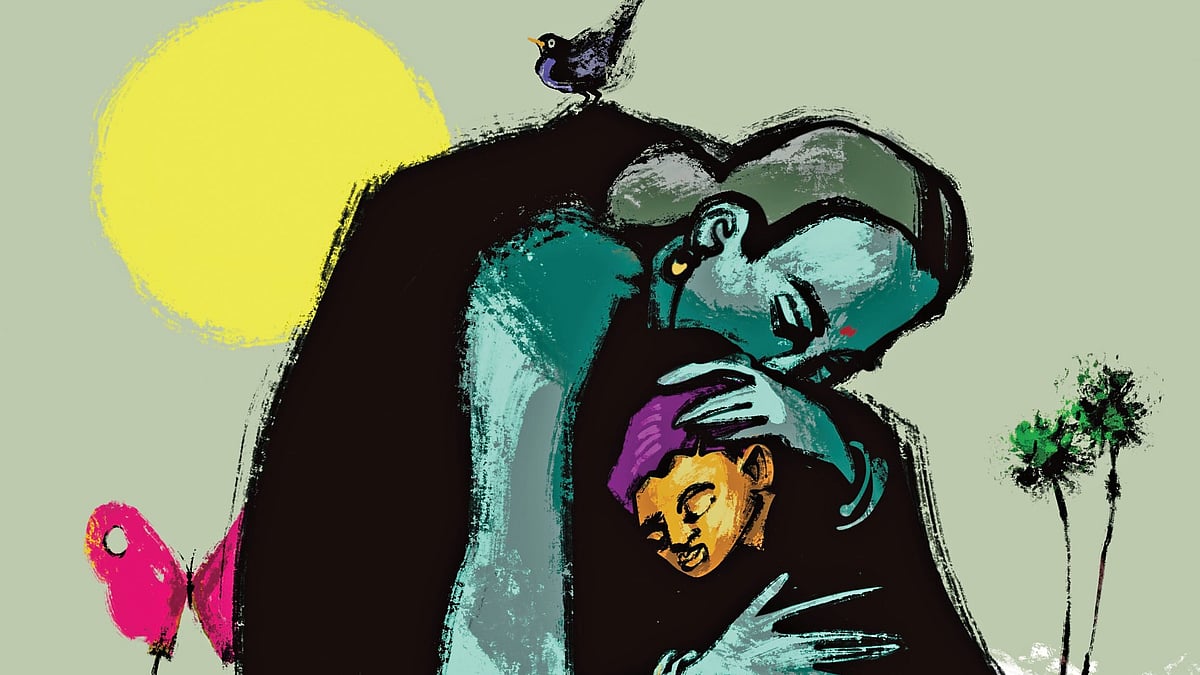
I could not sleep a wink all night. I kept twisting and turning. The rooster crowed. Birds tweeted. Dawn arrived in tiptoes. As darkness departed, light arrived.
I thought, ‘Now, thaṅgachchi would be walking into the light.’
1969


Leave a Reply