
இணை
Translated from the original Tamil short story iṇai (இணை) from the 1976 collection of short stories titled kōṭukaḷum kōlaṅkalum (கோடுகளும் கோலங்களும்) by Kuppilan Ai. Shanmugan. The original collection is available at noolaham.org. If you have any questions, please contact ez.iniyavan@gmail.com.

Anguish pervaded his entire being. He felt that these two months since their wedding had been incomplete. He wondered what this nameless impediment was. That which was bubbling up from within his chest, that which irritated him like a thorn on his side, that which threaded within him like a strand of sadness, that which stood in the way of a beautiful, complete, union of his and her emotions.
He felt that he understood it. But at the same time, he also felt that he did not.
He loved her for five years before he married her. He was firm in his resolve, ‘If I am to live, it is with her.’ He withstood countless challenges to live this life with her. He hurt the feelings of so many loved ones, and tearfully tore asunder so many strong familial bounds.
She stood by him in that ideological quest. She, too, was shaken by many sorrows. She cried on many occasions. She wept uncontrollably in many others. She went without food or sleep for many days.
He knew all that.
She knew all that.
They had unshakeable faith in the love they had for each other. If she laughed, he laughed. If he cried, she cried. He laughed because he wanted to make her laugh. She laughed because she wanted to make him laugh.
They experienced the joy that the world feels during the spring season. They feared the whirlwind and the frightening thunder that roared in pitch darkness. They rejoiced in the feeling of singing while sailing in calm waters. How quickly time flew then; Moments crawled; time stopped to watch them admiringly.
He leaned against the door frame and looked up at the sky. The tops of the coconut palms by the well in the front yard were darkened. Their leaves rustled intermittently in the gentle breeze. Twinkling stars were strewn all over the sky, like a sea of golden ear studs.
He turned to look inside the house to see where she was. The pale-yellow light from the glass lamp was weak. As the window curtain slithered in the wind, the rays of light oozed out to cast patterns on the outside. There was a deep silence within the house. One could hear the old woman pounding arecanut in her little corner. Perhaps she was in some room, reading.
She yawned.
How they had yearned for solitude like this! Those rare moments of solitude.. they were precious moments of joy. The sorrows of solitude, the burdens, the sadness, the worries… those moments when they shared these with each other, when they understood each other, when their fingers gently wiped the tears rolling down, when the gentlest of smiles graced their lips, when they immersed themselves in their joint laughter, when they embraced each other, when they buried their faces in each other’s chest or shoulder to weep, when they had a tiff and then made up.. Joys, joys they were. Are these the meaning of married life? Nay of life itself?
A wall clock in the living room was tick-ticking away with immaculate precision. A gecko uttered something in its own language. A male voice laden with the weight of age wafted over the air from the neighboring house chanting a devotional song by the Tamil saint Chuntaramūrtti:
pittạ̄ piṟai cūti perumạ̄ṉē aruḷạ̄ḷạ̄ [O madman with the moon-crowned hair, God of grace]
eittạ̄lmaṟa vạ̄tē niṉaikkiṉṟēṉ [O Lord, how can I forget you?]
He remembered. The temple chariot crawled, gently swaying from side to side. The bhajanai troupe chanted and danced. The karakạ̄ṭṭam folk dancers swirled. Devotees carrying kạ̄vadi danced to the accompaniment of nạ̄tasvaram and traditional thavil drumming. From time to time the fragrance of incense sticks drifted over in the wind and captured one’s heart. Little children gallivanted in the jaggery-water stalls set up to quench the thirst of devotees. The multitudes in silk vēṭṭi sạ̄lvais, silk sarees, and colorful frocks inched forward. The loudspeaker was belting out a Tamil song. It was then he saw her.
His eyes widened in wonder.
Has the onslaught of time given her such a sheen?
How she has grown up! Slim, tall, fair, attractive, … thick, long, black, wavy locks….
She saw him, too.
The black pupils of her eyes darted hither and thither.
With a gentle smile, she turned her head away.
He had last seen her about four years earlier. That, too, was at some temple festival or a wedding celebration, he remembered vaguely. He remembered her as a little girl, running around in a silk skirt.
“Appanē murukạ̄,” he could hear an old woman moan. He heard the jingling of running water as some neighbor was drawing water from the well in the yard. He also heard the bustle of the cows and calves standing under the eave.
He started doing his rounds on his bicycle at exactly the same time every day. First a pair of excited eyes were visible through the hole in the cadjan fence. In due course of time, the eyes smiled. The fence hole grew bigger until her entire face blossomed through it like a red lotus flower.
One day, he asked, “How are you?”
She responded with a slight smile on her lips.
“How are you?” he repeated the next day.
“I am fine,” she responded.
Thus began their life of sweet tussles. Sweet tussles indeed. Is life nothing but sweet tussles?
He left the door frame to sit on the front step.
He reflected on how that sweet life turned into a life of tussles.
He reflected on those who stubbornly insist on maintaining caste barriers for no good reason. Although, luckily, he and she belonged to the same high caste, the economic and social status disparities between their families was enough reason for his relatives to rise in opposition to their liaison. But he had remained resolute. He was proud to wed her by overcoming fraternal, filial, and family bonds. He marveled at his resolve and ingenuity in overcoming all the obstacles thrown in their way by those in his family who opposed their liaison.
Nevertheless… nevertheless.
He had a nagging feeling that something was amiss in their relationship. On their first night together, in the faint yellow light, when he tried to embrace her, she gently removed his hands, and, like a lifeless doll, looked up at him with moist eyes. At that moment, he sensed a deep sorrow in her heart.
He consoled her by kissing her forehead and wiping away her tears.
“Piramiḷā, why are you crying?”
Why did you have to cry at a happy occasion like that? How we had looked forward to that joyous day, letting our imaginations run riot? One day when we were alone in pitch darkness, and I tried to do something, you said “Why are you always in such a hurry? There will be a time and place for everything. Why don’t you wait patiently?”
In my anguish at the time, I had said, “Why are you afraid? It is certain that we will be together.”
You were silent.
I, too, became silent.
“Piramiḷā, why are you crying?”
I married her out of love. I know the beauty of love. But that does not mean that I am beyond natural urges. I am a man. She is a woman. The yearning to know the secrets of creation sprung forth from within me. But I know that the goal of matrimony is not entirely the urge to learn the mechanics of creation.
“Piramiḷā, why are you crying?”
She just smiled, “The liaison between a low-status person and a high-status person does not make them equal, does it?”
He understood. But he keenly felt the anguish that comes from powerlessness. His loved ones, his kith and kin, did not indeed respect his wife. But did that require him to yield some things to her once they became man and wife, understanding, and loving each other, seeking solace in each other, living for each other? Is marriage nothing but the dregs of society forsaken by others coming together to forget their sorrows of loneliness to find solace in each other?
The wall clock rang nine times and went quiet.
“Come to eat.”
He looked up from the front step. She stood there, with her beauty shimmering through. How charming is her smile! How pure and without blemish she is! She who has dedicated herself to him, and lives for him, she who is his.
A rush of thoughts crowded his mind.
“Why do you look at me like this? Come to eat, won’t you?”
He stood up and took hold of her hand and kissed lightly on her forehead. “Piramiḷā, I understand you; I will live for you.”
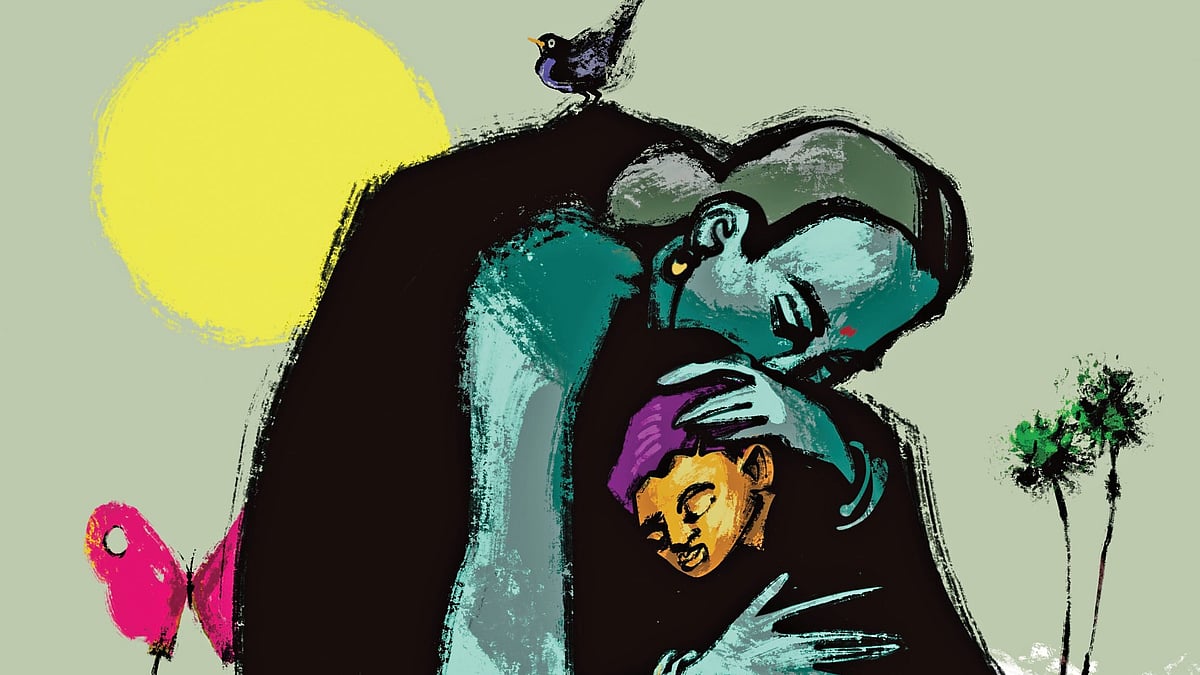
She held his hands tightly, buried her face in his shoulders, and wept.
1971


Leave a Reply